
گرمایش از کف چیست؟
The system in which the heating of the building is done through the floor and by installing pipes in this area can be called underfloor heating. In this method, the floor of the house acts like a radiator and the heat reaches other parts. For floor heating, you can use two methods: central boiler and electricity. The water heated by each of these sources circulates in the pipes embedded in the floor and in this way it can heat the space well. In this method, separate pipes are used for heating each room and place of the house so that you can easily control the amount of heating in different parts. Therefore, you can spend less energy and reduce the amount of heating for rooms and spaces that are used less.
The benefits of the floor heating system
Low energy consumption and reduced energy consumption
High efficiency of high heating system
Uniform distribution of heat in all parts of the building
No space occupied by radiator or heater panels
Keeping the floor dry and not sweating when cold air enters
Reducing the flow of cold air in the building
Creating a sense of peace and comfort for residents
The applications of the floor heating system
Residential buildings
Commercial buildings
Buildings with limited space
Educational buildings
Healthcare buildings
Sports buildings
Large and complex buildings
Residential buildings
It is very popular due to the creation of uniform and comfortable heat in the entire space of the building. This system is a good choice especially for families with young children who care a lot about the proper temperature of the environment.
Business buildings
Due to its beauty and elegance, it is a good choice for luxury and modern environments. Also, this system increases the productivity of employees due to the uniform distribution of heat in the environment.
Office buildings
It is a suitable choice for work environments due to the creation of a quiet and noise-free environment. Also, this system helps to save building costs due to reduced energy consumption.
The buildings with space constraints
It can be a suitable option for heating buildings with limited space, such as basements and garages. This system can be suitable for these types of buildings because it does not require a lot of space to install heating equipment.
Training buildings
It is a suitable choice for educational environments due to the creation of a healthy and hygienic environment. Also, this system increases students' concentration due to the uniform distribution of heat in the environment.
Health buildings
It is a suitable choice for therapeutic environments due to the creation of a calm and noiseless environment. Also, this system helps to save the hospital costs due to the reduction of energy consumption.
Sports buildings
It is a suitable choice for sports environments due to creating a favorable environment for athletes. Also, this system increases the safety of athletes due to the uniform distribution of heat in the environment.
The types of floor heating systems
Blue -floor heating system
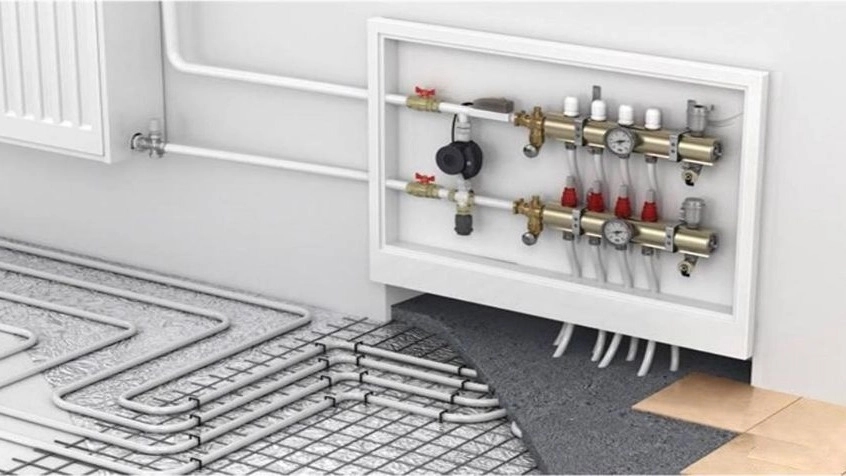
One of the methods of the underfloor heating system is water, in which a network of water pipes is used. These pipes are usually less thick than water pipes and are placed under the floor covering of the building. Hot water flows in these pipes and in this way, the surrounding environment is heated to the desired level. The required heat of the environment is provided through the package or the central engine room system. It is possible to control the ambient temperature easily by controlling the water temperature.
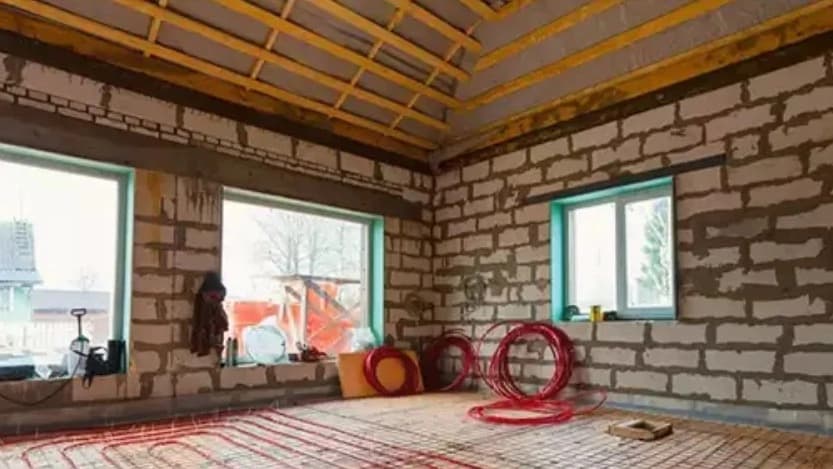
To install this system, all mechanical and electrical equipment must be installed and cemented on the floor of the building. Then, all the floors and sides must be well insulated so that the heat produced does not spread anywhere else other than the intended environment. After this step, the net should be widened at the installation site and Pex pipes, which have high flexibility, should be used in a large area.
These pipes are fixed on the network pipes. In the next step, these pipes should be drawn to a collector or the same distribution box to be connected to a main valve from their branch. The collector provides the possibility of ventilation of the pipes as well as opening and closing them for water flow. Finally, this collector is connected to the package or the central engine room to provide hot water flow. Then the final cementing and flooring is done on the pax pipes.
Electric floor heating system
In these systems, an element network and a power source are used to produce the required heat. In the past, elements were usually placed under the floor covering of the building, and then these elements were connected to the power source to finally start the system. Today, with the advancement of technology in this field, element carpets have been designed and made, which can be They were used under the main covering of the building, such as parquet, laminate, etc., and there is no need to use various building materials in this field.
This electric system model actually consists of a network of fixed elements to a non-conductive plastic network, which are sold in rolls. To implement this system model, all the required mechanical and electrical installations need to be implemented and covered with cement.
This model of floor heating system also needs strong insulation so that the generated heat is not directed to unwanted places. After the required insulation works, it should be started to connect it to electricity. The coating on the system can also be stone, ceramic or parquet, and there are no restrictions in this field.
Flooring suitable for the floor heating system
When you use underfloor heating to provide heat to the environment, you must be very careful in choosing the floor covering. In this context, you can use coverings such as tiles, stones and similar products without restrictions. Usually, absorption and distribution of heat and heat are transferred well with these covers and there is no obstacle in their path.
How to control the floor heating system
Controlling the underfloor heating system is easily possible and there is no need to worry about it. There are two ways to control this system. The first part is related to the digital control that can be used to manage and determine the amount of heat in each room and environment. The second part is related to controlling the heating system in different parts of the house. The digital part is usually installed in a place so that the user of the system can easily access it and on the other hand it is not visible.